




 |
January 12, 2026
|
3:02 PM
|
January 12, 2026
|
3:02 PM
 4 min read
With the World Economic Forum’s annual meeting in Davos approaching, many of the conversations shaping global markets are shifting—from ambition to execution, and from narrative to performance.
From his position working at the intersection of agriculture, environmental markets, and global supply chains, Tim Weaver has a front-row seat to how those shifts are playing out on the ground—and in capital markets. What he sees is a growing recognition that food security, water risk, and climate resilience are no longer peripheral sustainability concerns. They are economic fundamentals, increasingly tied to inflation, fiscal stability, insurance exposure, and geopolitical risk.
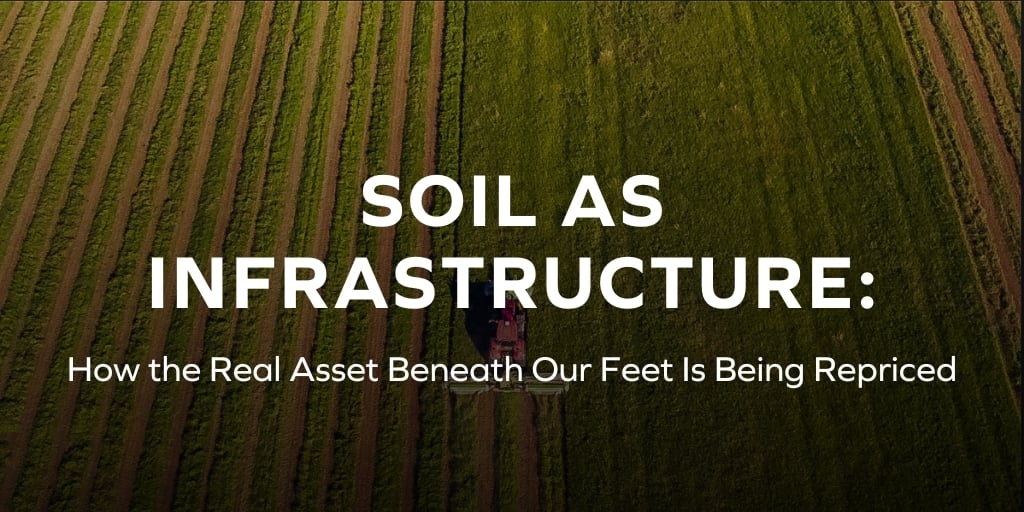
Soil As Infrastructure: How the Real Asset Beneath Our Feet Is Being Repriced
For some, the global sustainability conversation has entered a different phase.
What began as frameworks, pledges, and disclosure regimes is now being tested by markets, geopolitics, and systems stress. Food security, water scarcity, and climate resilience are no longer just side conversations for ESG panels. For many global corporations, governments, and their financial backers, these dynamics have become economic fundamentals – with direct implications for inflation, fiscal stability, supply chains, and political risk.
At the center of it all sits the asset we still struggle to describe correctly:
Soil.
Not as sentiment.
Not as symbolism.
But as infrastructure.
From Output to Reliability
When one opens up the aperture, food security today is more than a measure of how much we can grow in a good year. It’s increasingly about whether systems perform when conditions deteriorate. Volatility across weather, inputs, and geopolitics has turned yield variability into price shocks, insurance losses, and political pressure.
From a financial perspective, degraded soils shorten the productive life of land and amplify downside risk. Functional soils do the opposite: they stabilize output, reduce dependency on inputs, and extend asset durability. Markets are increasingly recognizing the differences. As a result, governments and corporations are beginning to price soil performance, quietly and unevenly for now, but with growing intent and consequences.
This isn’t ideology presented in the chords of a folk song. It’s system performance.
Water Is the Constraint Everyone Knows Yet Few Can Hedge
Water is one of the least diversifiable risks in the global economy. It’s local, immobile, and increasingly constrained.
Farmers understand this intuitively. Too much, too little, or at the wrong time can collapse the economics of a season—and sometimes a community.
Corporations are catching up. Water has moved from a sustainability disclosure to a sourcing risk and, increasingly, a cost-of-capital issue much like energy once did. The difference is that energy can be hedged. Water, however, cannot be shipped in. Dry basins don’t respond to spreadsheets.
Governments already live downstream of this reality. Water scarcity sits upstream of food prices, insurance losses, infrastructure strain, and political instability. It is non-fungible and unforgiving.
What has been known to science, and is now becoming clear to the markets, is that water performance depends on soil performance. Biologically functional soils absorb rainfall, store it, and release it predictably. Healthy soil offers a scaled solution to groundwater issues that continue to mount. Degraded soils convert precipitation into runoff, erosion, and loss, in places also pulling from that limited resource of water in our aquifers.
As water risk moves from narrative to underwriting through insurance, credit, and sourcing decisions, soil function becomes a first-order variable.
Climate Resilience Is Built, Not Offset
Resilience doesn’t scale through abstractions or algorithms. It scales through systems that behave better under variability. Working at the intersection of growers, global supply chains, and environmental markets through Holganix, I see this play out daily.
Soils with structure, biology, and carbon depth moderate extremes. They absorb heavy rainfall, retain moisture through drought, and maintain productivity through disruption. These characteristics translate directly into reduced volatility, improved reliability and longer asset life.
This is a pattern familiar to infrastructure policy, development, and financing, a pattern with predictable outcomes.
Environmental Assets Are Entering the Capital Markets
For years, environmental assets were shaped by committees and groups that were thoughtful, principled, and often theoretical. The result was constrictive standards without liquidity and credits often unprotected by market scale that suffered from both lack of confidence and well-meaning attacks.
That phase of this market’s development is transitioning into something more tangible. Carbon, water performance, nutrient efficiency, and resilience are evolving from abstractions into commodities—and in some cases, financial instruments. And once finance holds the pen, the questions become familiar:
Is the asset measurable and repeatable?
Does it perform adequately under scrutiny?
Can it be produced at scale?
Will capital trust it through cycles?
Markets don’t scale on intent. They scale on performance.
A Reframing for Davos
Historically, infrastructure meant roads, ports, and power grids. In a world defined by volatility and supply-chain challenges and advantages, soil belongs on that list.
Healthy soil infrastructure underpins food systems, water availability, and climate resilience simultaneously. When it degrades, risks compound. When it performs, systems stabilize and thrive—economically, environmentally, and politically.
This reframes soil from an agricultural ingredient into a strategic asset—one with direct implications for national stability, fiscal exposure, and long-term growth.
As leaders gather in Davos, the question is no longer whether these fundamentals matter. It is which political and financial leaders have already begun treating soil systems with the seriousness applied to any other critical infrastructure.
Academic frameworks opened the door.
Markets are now walking through it.
Like all financial, political, and even biological systems, performance will decide what grows and flourishes once through the door and into the arena.

.png)
.jpg)
-1.jpg)
-1.jpg)
.jpg)
-1%20(1).webp)
-831535-2.webp)



- blog (404)
- lawn care (354)
- agriculture (217)
- golf course (193)
- sports turf (190)
- holganix reviews (160)
- story (126)
- farmers (31)
- Holganix Bio 800 (30)
- soil health (26)
- Holganix Bio 800+ Revive (17)
- soil (16)
- trees (16)
- holganix case studies (15)
- Holganix Bio 800 Breakdown (14)
- webinar (13)
- Soil heath (12)
- Holganix Bio 800 Agriculture (11)
- carbon (10)
- soil microbes (9)
- HGX (8)
- crop residue (8)
- holganix results (8)
- Gratitude (6)
- core values (6)
Related Posts
.png)
 10 min read
 11 min read
 2 min read