




 |
April 10, 2026
|
3:09 PM
|
April 10, 2026
|
3:09 PM
 6 min read
Increasingly companies are being asked to report on their greenhouse gas (GHG) emissions—especially Scope 3, or the emissions that occur across supply chains. And candidly, that’s easier said than done.
So let’s take a step back.
How do you measure something that happens across thousands of farms, each operating differently?
Historically, we’ve relied on estimates, averages, or models to approximate what’s happening in the soil, the same soil that connects to the products and companies we interact with every day.
That’s the gap we’re working to close at HGX, by bringing actionable, farm-level data into the conversation.
Let’s be candid: GHG inventories and accounting protocols can be intimidating.
Instead of starting with a spreadsheet, let’s start somewhere more familiar…a movie theater.
The Scene
At the risk of severely dating myself, I’ll set the scene. It’s a hot Friday night in midsummer, 2004, in a small town in Arkansas. The kind where the only real escape is the air conditioning of a movie theater. A line of teenagers waits at the concession stand. Popcorn. Candy. Drinks. Simple enough. But behind that bag of candy and popcorn is an entire value chain: ingredients, suppliers, and processes that stretch far beyond the theater itself.
And embedded in that value chain is something most people rarely think about: emissions, or the carbon footprint that it took to get that product into your hand at the theater.
The Role
Now, imagine that you work for the company that makes those snacks. Your job is to calculate the emissions associated with your product. Where do they actually come from?
Framing Emissions
To answer that, companies rely on a common tracking framework: Scope 1, 2, and 3 emissions.
Scopes 1 and 2 are relatively straightforward. The oversimplified version is that those emissions categories come from your own business operations and the energy required to run them. Think of them as what you burn (natural gas, diesel fuel, etc.) and what you buy (purchased electric power, or steam for heating). If you want to dive deeper into this topic, I recommend the following resource: https://ghgprotocol.org/scope-2-guidance
Scope 3 is everything else, and often the biggest piece of the puzzle. Here is where things get interesting!
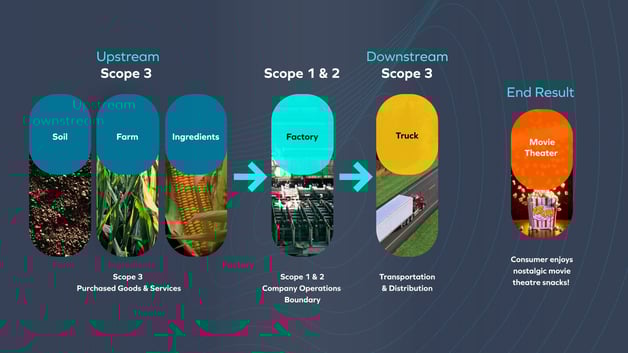
Most Scope 3 emissions originate upstream—at the farm level—where data has historically been estimated. Today, in-field soil data makes these emissions measurable.
The Plot
For food and beverage companies like the movie theater snack brand in our example, a large share of the overall emissions inventory comes from upstream sources, potentially hundreds of miles or even continents away, embedded in a supply chain of packaging materials and agricultural raw ingredients called “Category 1 Purchased Goods and Services” that extends beyond arable land. For example, Category 1 Purchased Goods and Services includes the kernel of corn and what it took to produce that kernel. This means that what happens on farms and within the soil where these crops are grown matters more than ever.
Connecting the Dots
To grow the ingredients behind those nostalgic snacks, like corn, sugar, cacao, peanuts, and wheat, they all need the same basic thing: topsoil. Picture a corn grower in the US Midwest, or a wheat producer on the expensive plains of Alberta. Producing crops at a commercially viable scale requires inputs: land, labor, equipment, irrigated water, and often significant amounts of synthetic fertilizers to maintain yield. Each of those inputs carries its own GHG emissions footprint, which contributes to Scope 3. (For more technical guidance on Scope 3 categories, both upstream and downstream, check out this resource: https://ghgprotocol.org/corporate-value-chain-scope-3-standard)
For teams responsible for calculating Scope 3 emissions, this poses a real challenge. How do you measure something that occurs at the field level across thousands of farms, each operating differently? All too often, the answer hasn’t historically been a true measurement. We’ve relied on estimates, averages, or models to approximate what’s happening in the soil.
Soil Data In Action
This is one of the gaps that we’re working to close for upstream agricultural emissions. With in-the-field soil data, a snack company can begin to:
- Understand on-farm emissions drivers on a seasonal or crop rotation basis;
- Identify opportunities, including novel product innovations, that help growers reduce inputs, not just occasionally, but season after season; and,
- Quantify and deploy capital investments in environmental and operational outcomes.
Where This Comes to Life
At Holganix and HGX, this is exactly where we’re spending our time. Not because it’s the only category of the Scope 3 emissions puzzle that matters, but because it’s one of the least visible, yet most impactful.
We’re focused on bringing actionable, farm-level data to the conversation and reducing the burden on growers to manage it. In my role at HGX, I naturally gravitate towards how companies are structured to account for this complex web of supply chain actors, and how they deploy capital to influence the outcomes to strengthen their access to source ingredients. That bag of movie theater popcorn is beautifully simple. But its footprint tells a much deeper story, one that starts long before you enjoy it. As we get serious about Scope 3, that’s where we have to look. Stay rooted!
.png)
.jpg)
-1.jpg)
-1.jpg)
.jpg)
-1%20(1).webp)
-831535-2.webp)



- blog (404)
- lawn care (354)
- agriculture (217)
- golf course (193)
- sports turf (190)
- holganix reviews (160)
- story (126)
- farmers (31)
- Holganix Bio 800 (30)
- soil health (26)
- Holganix Bio 800+ Revive (17)
- soil (16)
- trees (16)
- holganix case studies (15)
- Holganix Bio 800 Breakdown (14)
- webinar (13)
- Soil heath (12)
- Holganix Bio 800 Agriculture (11)
- carbon (10)
- soil microbes (9)
- HGX (8)
- crop residue (8)
- holganix results (8)
- Gratitude (6)
- core values (6)
Related Posts
.png)
 3 min read
 4 min read
.png) 6 min read
6 min read