




 |
June 25, 2026
|
10:00 AM
|
June 25, 2026
|
10:00 AM
 4 min read
.jpg?width=1024&height=512&name=2026%20Blog%20Header%20Template%20(17).jpg)
For years, farmers have fed their crop from the top down: with fertilizer, field passes, and more inputs. But with the surge in prices these days, inputs are getting harder to justify.
The good news is that growers are already sitting on a bank of nutrients stored in their soil. The problem is unlocking it.
That’s where rhizophagy comes in. This natural, biological process can free as much as 30% more nitrogen from the soil.
What does that mean for the crop?
- Better nitrogen efficiency
- Reduced fertilizer needs
- Stronger root systems
- Improved stress tolerance during dry conditions
- Better resilience overall
And maybe most importantly, it means more return from every dollar spent on inputs.
How Rhizophagy Works
In the rhizophagy cycle, plants work together with beneficial microbes in the soil to gather nutrients. Think of those microbes as tiny nutrient miners living around the roots.
The plant actually pulls microbes into the root, extracts nutrients like nitrogen and phosphorus, and then sends surviving microbes back out into the soil to repeat the process.
It’s a nutrient delivery system built by nature.
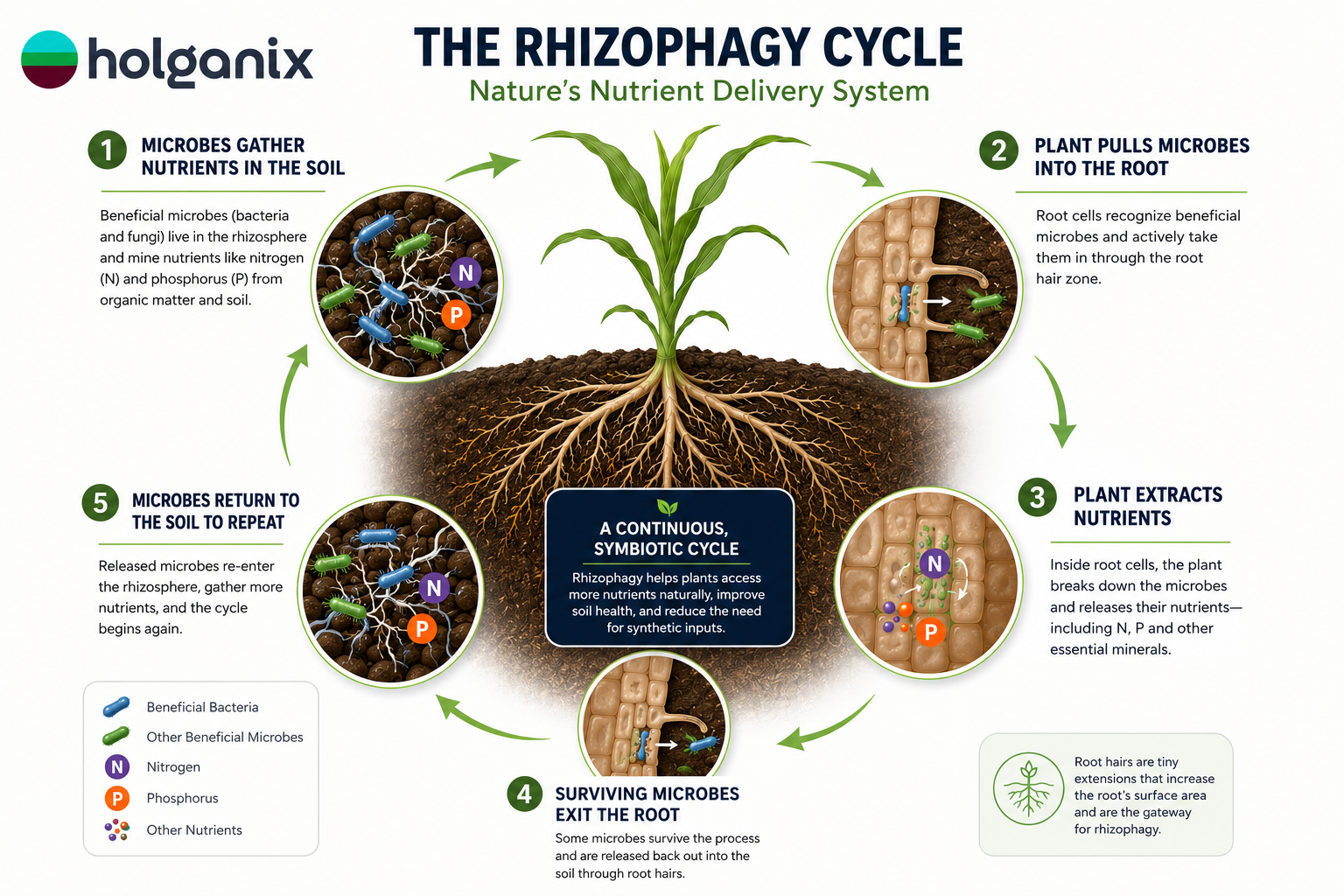
How to Know If Rhizophagy is Happening in the Soil
Healthy biological systems often show up as:
- More root hairs
- Better root mass
- Improved soil aggregation
- More active rhizosphere soil around the roots
.jpg?width=1640&height=924&name=Facebook%20Posts%20(34).jpg)
.jpg?width=1640&height=924&name=Facebook%20Posts%20(35).jpg)
Modern Farming Can Interrupt the Process
Intensive farming practices can disrupt the rhizophagy cycle over time.
Heavy synthetic use, aggressive chemistry, and limited biological diversity can reduce microbial activity in the soil. When that happens, the plant loses part of the natural nutrient partnership it was designed to use.
The crop becomes more dependent on outside inputs because the soil biology has stopped functioning naturally.
Biologicals Support the Rhizophagy Cycle
That’s why we created Bio 800+, to put life back in the soil. With over 800 species of microbes, Bio 800+ helps support the rhizophagy cycle by:
- Introducing beneficial biology
- Creating an environment where microbes can thrive
- Supporting biological activity around seedling roots early in the season
Healthy soils are not just dirt holding fertilizer. They’re living systems. And when they’re balanced:
- Nutrients cycle more efficiently
- Roots explore deeper
- Plants handle stress better
- Inputs work harder
- Soils become more resilient over time
That’s good for the crop, good for the farm, and good for the future of agriculture.
How Healthy Are Your Roots This Season?
Dig them up and find out. The 2026 Roots Competition is your chance to see how your root systems compare with growers across the country and showcase the results of your soil health efforts. Strong roots are often the first sign that your biology is working, nutrients are cycling efficiently, and your crop is better equipped to handle stress throughout the season. Enter the 2026 Roots Competition today and show us what's happening below ground: https://www.holganix.com/2026-roots-competition.
.png)
.jpg)
-1.jpg)
-1.jpg)
.jpg)
.jpg)
-1%20(1).webp)
-831535-2.webp)

- blog (404)
- lawn care (354)
- agriculture (216)
- golf course (193)
- sports turf (190)
- holganix reviews (160)
- story (126)
- farmers (31)
- Holganix Bio 800 (30)
- soil health (26)
- Holganix Bio 800+ Revive (17)
- soil (16)
- trees (16)
- holganix case studies (15)
- Holganix Bio 800 Breakdown (14)
- webinar (13)
- Soil heath (12)
- Holganix Bio 800 Agriculture (11)
- carbon (10)
- soil microbes (9)
- HGX (8)
- crop residue (8)
- holganix results (8)
- Gratitude (6)
- core values (6)
Related Posts
 5 min read
-2.png)
 1 min read
-2.jpg) 5 min read
5 min read