




 |
July 8, 2026
|
2:45 PM
|
July 8, 2026
|
2:45 PM
 4 min read
.jpg?width=628&height=314&name=2026%20Blog%20Header%20Template%20(5).jpg)
There were nine days of London Climate Action Week—75,000 people, more than a thousand events, and conversations that brought together finance, food, technology, government, and agriculture in ways that would have seemed unlikely just a few years ago.
London spent the week in record June heat: schools closed early, offices emptied, and in a moment no satirist would dare invent, a session on extreme heat was cancelled because the venue was too hot.
A banker I met put the whole week in one sentence: "Our clients have stopped asking us how to price their climate risk. They're asking where they can buy resilience at scale and quality today."
That shift from pricing the problem to shopping for the solution was the story of London. And the most interesting place to find that solution may be eighteen inches beneath our feet.
Risk Walked Into the Room
For years, climate conversations revolved around targets, disclosures, and future scenarios. This year felt different. Physical climate risk wasn’t being debated anymore. It had already arrived. Conversations about water security, fertilizer supply, crop availability, and insurance weren’t hypothetical anymore—they were operational.
When resilience shows up in person, the discount-rate debate gets short.
The Bottleneck Has Inverted
Here is the structural surprise of the week: the money is no longer the missing piece.
Across investor meetings, there was no shortage of interest in financing climate and nature solutions. What was in short supply were investment-ready assets: outcomes that are measurable, verifiable, and durable enough to earn institutional confidence.
Agriculture sits squarely at the center of that opportunity. Healthy soil is one of the largest untapped real assets on the planet. It serves as a yield stabilizer, a water regulator, a carbon store, and an input hedge, sitting under 2 billion acres of working land. The challenge has never been whether those benefits exist. It’s been proving them consistently enough that markets can value them. You cannot underwrite what you cannot measure.
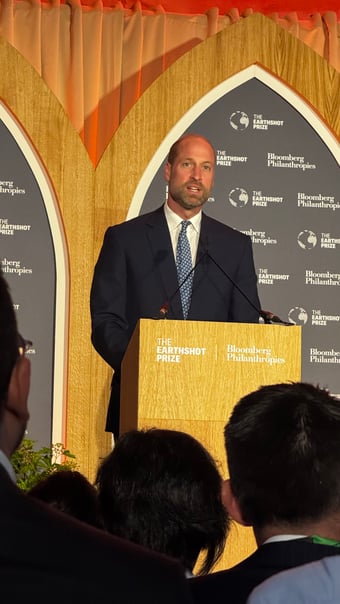
Prince William’s message was clear: the solutions exist. The challenge now is scaling them with measurable results.
When Procurement Starts Asking Different Questions
The sharpest urgency in London came from an unexpected department.
With geopolitical instability squeezing oil, gas, and fertilizer supplies, the food and beverage conversations had a new center of gravity. Sourcing leaders weren't asking how to decarbonize their growing regions. They were asking how to de-risk them, how to reduce the fossil-input dependency of the farms they rely on before the next price spike, not after.
The Growers Had the Best Line of the Week
The quiet structural change in London: farmers were in the rooms as primary sources, not photo opportunities. Sessions were built around farmer-led research and grower testimony, and their message should reassure every CFO who has ever winced at the word "regenerative."
They didn't change practices to save the world. They changed practices to pay the bills. Lower input dependency. Water that stays in the root zone through drought. Yields that hold through volatility. One UK farmer described a regenerative journey that began a decade ago not with idealism but with an unpayable invoice.
It’s the same arithmetic we see every week at Holganix across millions of acres. When healthier soils deliver measurable economic returns, adoption doesn’t depend on ideology—it makes business sense.
What London added was seeing the rest of the value chain finally catch up. Farmers want stronger margins. Food companies want reliable supply. Banks want investable assets. Governments want food security. Different motivations. One asset. Nobody in that alignment needs to share values. They need to share soil.
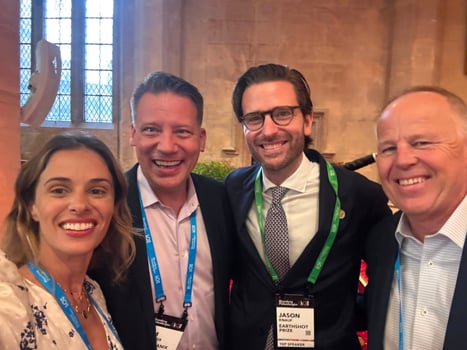
(Left to right) Lily Buffett, Tim Weaver (Chief Strategy Officer, Holganix), Jason Knauf, and Bryan Hansel (Chief Commercial Officer, Holganix) during London Climate Action Week 2026.
What We Packed in our Bags to Carry Home
London’s theme was “cooperation in a fragmented world.” I left thinking the bigger story was convergence.
Healthy soil has become one of the few places where business, agriculture, and climate interests are beginning to align.
That’s a meaningful shift.
Soil is no longer just part of the sustainability conversation. It’s becoming infrastructure.
As the conversation moves from London to Climate Week NYC, COP31, and Davos, the question is no longer whether resilient agriculture matters. It’s how quickly we can build it at the scale the moment demands.
Because the resilience economy isn’t forming anymore.
It’s placing orders.
.png)
.jpg)
-1.jpg)
-1.jpg)
.jpg)
-1%20(1).webp)
-831535-2.webp)



- blog (404)
- lawn care (354)
- agriculture (217)
- golf course (193)
- sports turf (190)
- holganix reviews (160)
- story (126)
- farmers (31)
- Holganix Bio 800 (30)
- soil health (26)
- Holganix Bio 800+ Revive (17)
- soil (16)
- trees (16)
- holganix case studies (15)
- Holganix Bio 800 Breakdown (14)
- webinar (13)
- Soil heath (12)
- Holganix Bio 800 Agriculture (11)
- carbon (10)
- soil microbes (9)
- HGX (8)
- crop residue (8)
- holganix results (8)
- Gratitude (6)
- core values (6)
Related Posts
-1.jpg)
 13 min read
-1.jpg) 4 min read
4 min read-2.png)
 1 min read