




 |
June 10, 2026
|
10:15 AM
|
June 10, 2026
|
10:15 AM
 5 min read
.jpg?width=628&height=314&name=2026%20Blog%20Header%20Template%20(6).jpg)
Farmers are in a critical period of decision-making. Fertilizer prices are at an all-time high, and growers are weighing whether cutting back on fertilizer is worth the risk to their crop performance.
Exciting new field data suggest that when soil biology is active in the system, nitrogen rates can be reduced without compromising plant health and productivity.
To support informed decision-making, we evaluated how pairing Bio 800+ with reduced nitrogen rates impacts both soil nitrogen availability and plant tissue nitrogen.
Trial Overview:
A 2025 corn trial in Northwest Ohio compared standard and reduced nitrogen programs, with and without Bio 800+ Revive. This was the first season Bio 800+ Revive was applied on this ground.
Treatments included:
- 100% fertilizer (control)
- 100% fertilizer + Bio 800+ Revive
- 80% fertilizer + Bio 800+ Revive (-20% N)
- 60% fertilizer + Bio 800+ Revive (-40% N)
Bio 800+ Revive was applied in-furrow at 0.5 gal/acre. Measurements were taken at key vegetative stages (V2, V5, V8) to assess both soil available nitrogen (Haney) and plant tissue nitrogen.
Soil Available Nitrogen
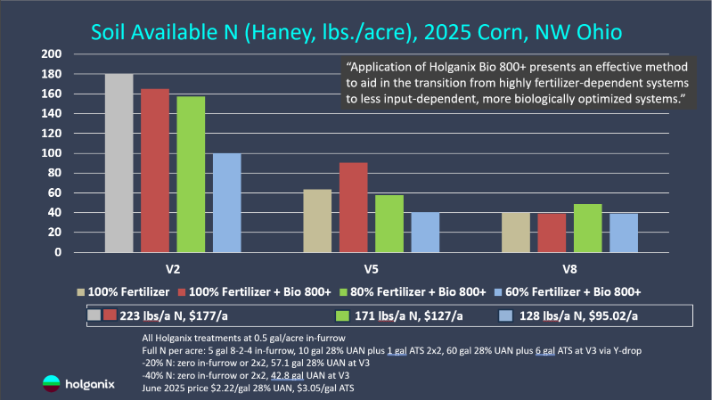
In the image above, the data demonstrates how biology impacts nutrient availability. The increased biological activity that comes along with the application of Bio 800+ is playing a role in nutrient cycling.
Rather than the crop relying solely on applied fertilizer, microbes mineralize and mobilize existing soil nitrogen pools.
As a result, nitrogen remains available throughout key stages of crop development, not just early in the season.
At the V2 stage, most treatments showed similar nitrogen availability, indicating adequate early-season fertility for crop establishment.
By V5, Bio 800+ treatments began maintaining higher available nitrogen levels, even at reduced fertilizer rates, suggesting increased microbial nutrient cycling.
At V8, this trend continued, with Bio 800+ treatments sustaining nitrogen availability later into the season when crop demand increases.
Takeaway: Soil nitrogen availability sustained, or increased, when treated with Bio 800+, even with 20-40% less nitrogen fertilizer.
Tissue Nitrogen
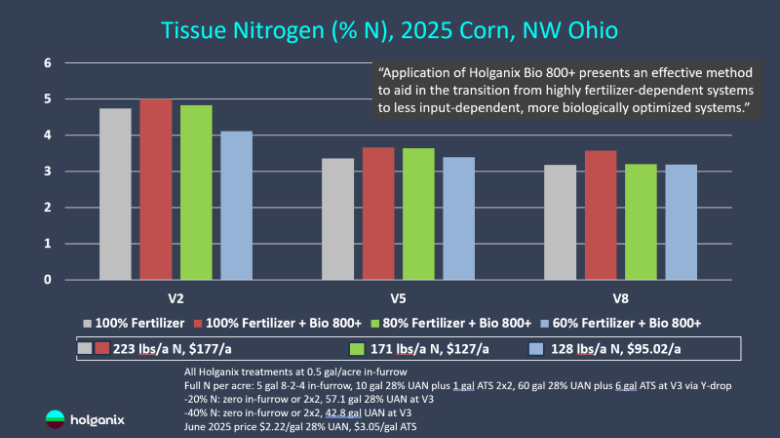
Maintaining adequate tissue nitrogen during vegetative growth is critical, particularly at V5 and V8 when nutrient demand increases.
At V2, tissue nitrogen levels were relatively consistent across treatments as the crop established early growth.
By V5, Bio 800+ treatments maintained comparable tissue nitrogen levels despite reduced nitrogen fertilizer rates, indicating improved nutrient uptake efficiency.
At V8, tissue nitrogen levels remained stable in the Bio 800+ treatments, showing that reduced fertilizer applications did not limit nitrogen availability within the plant during critical growth stages.
Takeaway: In Bio 800+ treated fields, tissue nitrogen levels were maintained under reduced N rates. Reduced application rates did not translate to reduced nitrogen within the plant.
Together, these results point to a system that is not only agronomically effective but also economically advantageous.
Reducing nitrogen rates by 20–40% resulted in estimated savings of $50–$80 per acre, based on current fertilizer prices. Importantly, these cost reductions were achieved without a corresponding decline in measured soil or tissue nitrogen.
These findings support a systems-based approach to fertility management, where soil biology contributes to nutrient availability alongside applied inputs.
For growers considering nitrogen reductions:
- Start with incremental reductions (e.g., 20%)
- Pair reduced fertility with biological inputs
- Monitor both soil and tissue nitrogen throughout the season
This approach allows for a measured transition away from highly fertilizer-dependent systems toward more biologically supported nutrient cycling.
Data tells a story, but our growers tell it better. Check out our recent blog featuring a Nebraska farmer who successfully reduced fertilizer inputs.

.png)
.jpg)
-1.jpg)
-1.jpg)
.jpg)
-1%20(1).webp)
-831535-2.webp)


- blog (404)
- lawn care (354)
- agriculture (217)
- golf course (193)
- sports turf (190)
- holganix reviews (160)
- story (126)
- farmers (31)
- Holganix Bio 800 (30)
- soil health (26)
- Holganix Bio 800+ Revive (17)
- soil (16)
- trees (16)
- holganix case studies (15)
- Holganix Bio 800 Breakdown (14)
- webinar (13)
- Soil heath (12)
- Holganix Bio 800 Agriculture (11)
- carbon (10)
- soil microbes (9)
- HGX (8)
- crop residue (8)
- holganix results (8)
- Gratitude (6)
- core values (6)
Related Posts
.png)
 10 min read
 11 min read
 2 min read