




 |
September 16, 2026
|
11:30 AM
|
September 16, 2026
|
11:30 AM
 6 min read
.png?width=628&height=314&name=2026%20Blog%20Header%20Template%20(2).png)
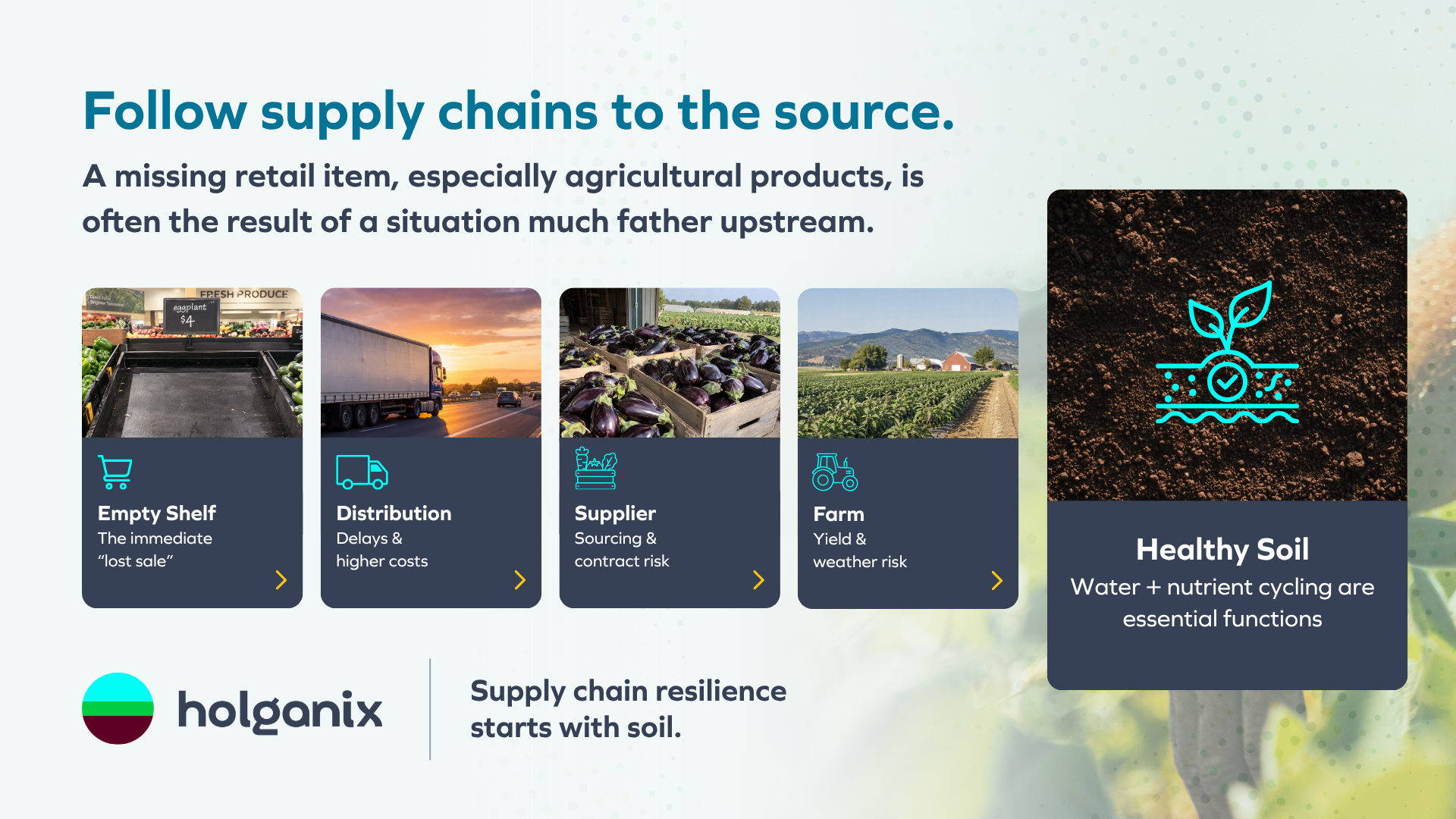
For a retailer, a missing product on the shelf may feel like a $4 miss at the point of sale. But the real cost ripples far beyond the amount from the consumer transaction. Products sourced from agricultural commodities face real disruption risk in 2026. Where can we start to unpack the value of supply chain resilience? Let’s start with the soil.
Last week, the key ingredient that I promised to bring home for family dinner wasn’t on the shelf. Eggplant parmesan and no eggplant, dang! I searched high and low, thinking perhaps the merchandising team moved it. No luck.
I thought about buying an alternative but in the end, I skipped it.
On the surface, that may feel like a simple problem: one product didn’t show up, for one reason or another, and the retailer missed my $4 eggplant purchase.
But what is the true underlying cost of a supply chain interruption? That question gets much more interesting once you look beyond the empty shelf.
The Ripple Effect
In the absence of their desired product, the shopper might choose a substitute. Maybe it’s cheaper. Maybe they like it better and never switch back. Suddenly, an empty shelf is no longer an inventory problem, it’s a customer loyalty problem.
Behind the scenes, the ripple effect is even larger. Procurement teams make emergency calls to suppliers and learn the stark reality: “Where are the eggplants? A global shortage from producers?!? From drought conditions?!”
They start searching for replacements, maybe from other suppliers. Once available again, suppliers may be on the hook to expedite shipping or risk contract underperformance. Finance absorbs higher costs or lower margins. Legal teams may have to revisit purchase contracts if the issues persist.
And the replacement itself may create other more persistent tradeoffs in consumer behavior. Is it more expensive? Lower quality? Imported from farther away? Inconsistent availability?
Suddenly, the cost of missing eggplants is spread across time, people, logistics, margin, customer behavior, and risk for the supply chain, extending well beyond the shelf where the problem was first visible.
Following the Supply Chain Back to the Farm
Consumer products may fail to be in stock for all kinds of reasons. Weather delays can cause shipments to be delayed, or a safety recall can halt inventory. A retailer could simply underestimate consumer demand for a specific product.
But agricultural supply chains have deeper, more unpredictable layer of risk: Crops depend on nature, and nature can be volatile. Sometimes, crop yields fail.
Persistent drought can significantly reduce harvest results across affected regions. Water can become too limited or too expensive to use for irrigation. Fertilizer prices can spike, forcing growers to make difficult input decisions that sacrifice yield. Weather patterns can disrupt planting windows and create stress on the crops at exactly the wrong time.
We saw this in 2024, when droughts across West Africa caused shortages in cocoa and shot futures prices skyrocketing by 66%1. And we’re seeing it today with unrelenting heatwaves in European markets, where this year’s grain forecast dropped by 9 million tonnes2.
Unlike a shipment delay, a crop that failed cannot be expedited overnight. That is where the conversation about supply-chain resilience starts to move upstream in the system and puts the farm into focus. And the farm depends on soil.
Soil Needs a Seat at the Table
For companies that depend on crops, healthy soil is not just an environmental pledge. As we’ve written before, soil is infrastructure - part of the foundation behind their product supply and revenue engine.
Healthy, biologically active soil can hold more water, cycle nutrients more effectively, and support crops through periods of stress. Those outcomes matter agronomically to growers because they can protect productivity. They also matter to food and beverage companies because resilient farms can support more resilient sourcing networks.
Regenerative agricultural practices do not make drought, inflation, geopolitical conflict, or logistics problems disappear. But investments toward resilience at the farm level can help reduce exposure. That brings soil health into focus not only for sustainability teams, but also for procurement, finance, operations, and enterprise risk leaders.
Building More Resilient Supply Chains
As a company in agriculture, we hear these sentiments shared daily in conversations with our growers. They are managing tighter margins, unpredictable weather, expensive inputs, and under pressure to keep producing yields reliably season after season.
At Holganix, our flagship product Bio 800+ starts on the farm, helping growers improve soil function and build greater resilience into their operations. In partnership with our science & data team, those farm-level outcomes generated by healthy soils can become investible building blocks for companies looking to create stronger connections to the agricultural supply chains they depend on.
That connection is becoming increasingly important for companies trying to strengthen their impact on agricultural sourcing and measure return on investment. Holganix is already creating measurable business and sourcing value with producers, while giving companies an avenue to direct capital towards resilience and environmental outcomes.
The Bigger Price Tag
Back to my missing eggplants. We ended up having breakfast for dinner, my favorite backup option.
The lost sales are easy to measure. Everything else that ripples out behind the scenes is much harder to put a price tag on. Let’s invest in avoiding those fire drills as a pillar of how we do business. Let’s start with investing in soil.
Stay rooted!
.png)
.jpg)
-1.jpg)
-1.jpg)
.jpg)
.jpg)
-1%20(1).webp)
-831535-2.webp)


- blog (420)
- lawn care (374)
- agriculture (221)
- golf course (202)
- sports turf (199)
- holganix reviews (168)
- story (132)
- Holganix Bio 800 (32)
- farmers (31)
- soil health (28)
- Holganix Bio 800+ Revive (17)
- soil (17)
- holganix case studies (16)
- trees (16)
- webinar (16)
- Holganix Bio 800 Breakdown (14)
- Soil heath (12)
- Holganix Bio 800 Agriculture (11)
- carbon (10)
- soil microbes (10)
- HGX (8)
- crop residue (8)
- holganix results (8)
- fertilizer (7)
- Gratitude (6)
Related Posts
-1.png)
 8 min read
 5 min read
-1.jpg) 2 min read
2 min read